Three-dimensional microscopy allows researchers to simultaneously record the activity of tens of thousands of neurons across brain regions, offering a vital window into understanding biological cognition and behavior. However, noise, light scattering, and the computational demands of terabyte-scale datasets make it difficult to extract neurons and their activity signals accurately and efficiently. These challenges remain a major bottleneck in large-scale neuronal imaging.
On September 7, 2026, a Tsinghua University team led by Qionghai Dai, Jiamin Wu, and Ruqi Huang introduced DeepWonder3D, an integrated, intelligent analysis framework. Their study, “Rapid robust high-fidelity 3D neuronal extraction from multiview calcium imaging datasets,” was published online in Nature Methods. DeepWonder3D extracts 3D neuronal positions and calcium activity traces directly from multiview projections. This method balances accuracy, temporal fidelity, and processing speed, providing an efficient and practical analytical tool for analyzing large-scale 3D neuronal imaging data.
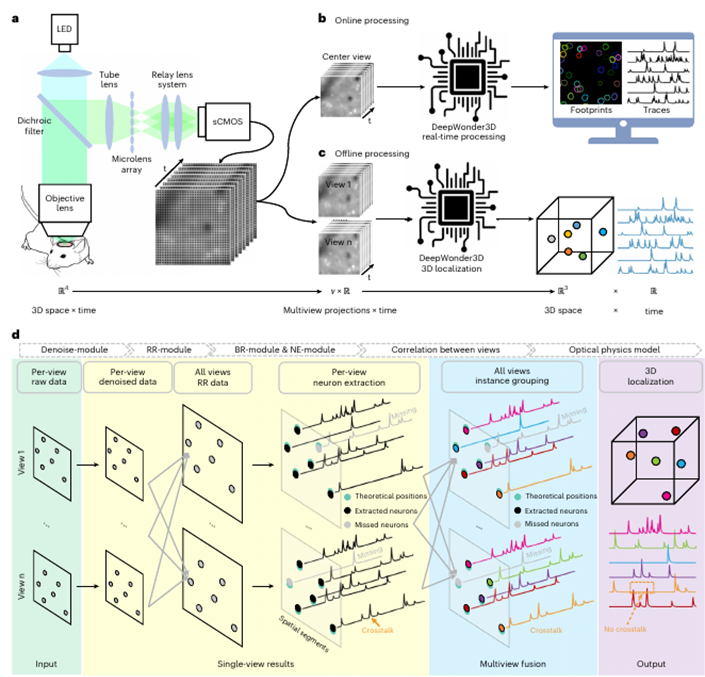
Figure 1. DeepWonder3D provides a general pipeline for 3D neuronal extraction directly from multiview projections.
At its core, DeepWonder3D directly leverages multiview information. DeepWonder3D integrates denoising, resolution registration, background removal, neuronal extraction, and multiview fusion into a unified pipeline. By suppressing noise and scattering and combining complementary information across views, the framework enables robust 3D neuronal localization and calcium signal extraction. This design balances signal quality with processing efficiency, turning large-scale imaging datasets into neuronal activity information that is ready for analysis.
To address the challenge of 3D training annotations, the team developed the NAOMi-LF simulator based on NAOMi [1]. The simulator creates a virtual cortex that incorporates neural structures, light scattering, and noise. In simulations, DeepWonder3D remained robust across varying neuronal densities, noise levels, and spatial resolutions, demonstrating its capacity for high-fidelity analysis of complex 3D data.
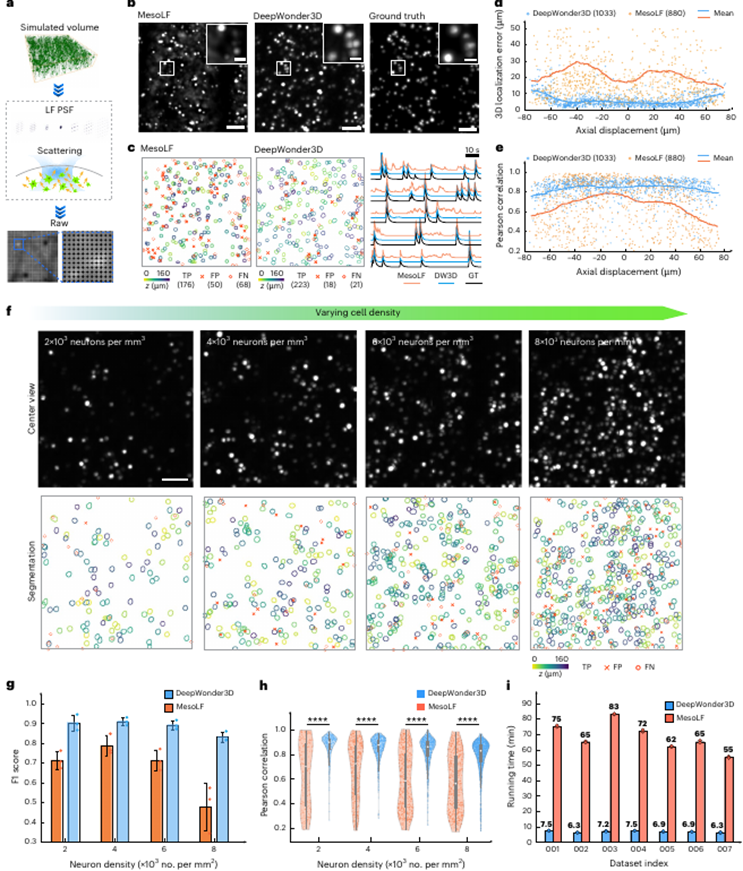
Figure 2. DeepWonder3D combines accurate neuronal extraction, temporal fidelity, and rapid processing
DeepWonder3D proves equally reliable in real living brain tissue. Validated through simultaneous hybrid two-photon and light-field imaging, the results demonstrate that the method accurately identifies neurons while faithfully preserving temporal calcium dynamics. Performance remained consistently robust across cortical regions and imaging depths. DeepWonder3D’s modular design allows flexible adaptation to point-scanning microscopy, light-field microscopy, and two-photon synthetic aperture microscopy [2]. In experiments using the RUSH3D mesoscope [3], DeepWonder3D efficiently analyzed terabyte-scale recordings from the cortex of awake mice. It extracted 3D positions and calcium signals from large neuronal populations and identified neurons concentrated in the visual cortex that exhibit orientation-selective responses to specific visual stimuli. DeepWonder3D maintained robust performance over larger fields of view and longer recordings, offering a practical tool for studying visual information processing and coordinated neural circuit activity across brain regions.
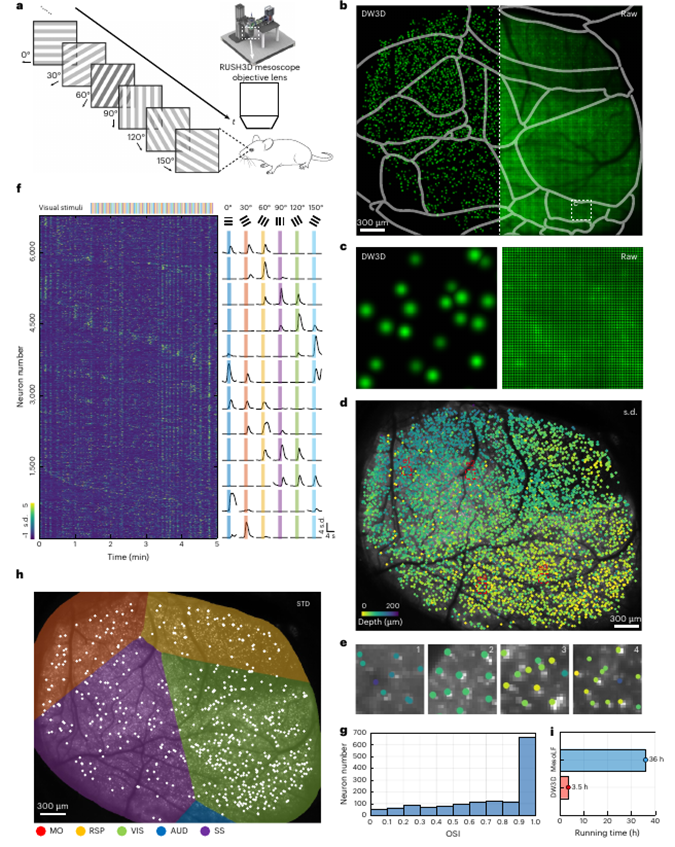
Figure 3. DeepWonder3D rapidly analyzes large-scale neuronal activity and visual stimulus responses in the mouse cortex imaged with RUSH3D mesoscope
DeepWonder3D drives large-scale neural imaging from massive raw datasets toward efficient analysis. The DeepWonder3D code and paired two-photon/light-field LF2Pneuron dataset have been made publicly available to facilitate reuse and reproducibility, serving as a shared resource for neuroimaging algorithm development. In the future, DeepWonder3D is expected to expand toward parsing finer subcellular neuronal structures and accommodating broader imaging modalities, helping to elucidate the functional principles of distributed neural circuits.
Ph.D. candidate Yujia Chen and Ph.D. Guoxun Zhang from Tsinghua University are co-first authors of the paper. Prof. Qionghai Dai (member of the Chinese Academy of Engineering), Assoc. Prof. Jiamin Wu, and Assoc. Prof. Ruqi Huang from Tsinghua University are co-corresponding authors.
Code: https://github.com/yujiachenjerry/DeepWonder3D
Dataset: https://doi.org/10.5281/zenodo.15383434

 Mailbox:qhdai@tsinghua.edu.cn
 Address:3rd floor, Central Main Building, THU, Beijing
 Fax:+86 10 62773433