On September 10, a multidisciplinary team from Tsinghua University published an article entitled “Initial Lessons from Real-world Implementation of an AI-Agent Eye Clinic in China” in Nature Medicine. Drawing on the development and real-world implementation of the AI-Agent Augmented Tsinghua Eye Clinic (AI-TEC), the article explores how medical artificial intelligence can move beyond the conventional “AI-assisted” paradigm centered on individual tasks toward an “AI-native” health system that deeply reshapes clinical workflows. It also summarizes key challenges and early lessons from bringing AI into real-world clinical practice.
Rapid advances in foundation models and generative AI have driven substantial progress in disease diagnosis, risk prediction and medical image analysis. Yet high-performing algorithms do not necessarily translate into more effective healthcare delivery. Real-world clinical care is not simply a collection of isolated tasks; rather, it is a complex system involving patients, clinicians, diagnostic devices, clinical data and interconnected workflows. The central question for medical AI is therefore shifting from “Can AI accurately perform a specific task?” to “Can AI truly integrate into clinical workflows and create measurable clinical value?”
From AI-Assisted to AI-Native Healthcare
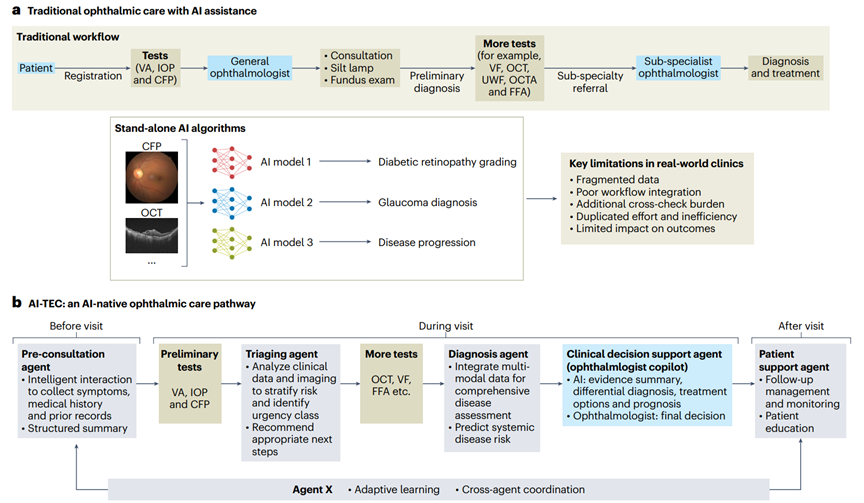
Most conventional medical AI systems are introduced into existing clinical workflows as standalone tools, with separate models performing tasks such as image analysis, disease detection or risk prediction. Clinicians must still review, interpret and integrate outputs from multiple AI systems. This AI-assisted paradigm does not fundamentally address systemic challenges such as fragmented clinical information, disconnected workflows and inefficient allocation of healthcare resources. In some cases, it may even create additional information-processing burdens for clinicians.
To address these limitations, the team proposes the concept of an “AI-native health system.” Rather than serving as an external tool added to existing workflows, AI becomes embedded throughout the clinical pathway, continuously organizing information, supporting decisions and coordinating care. The goal is not simply to deploy more AI models, but to rethink the role of AI within healthcare systems—shifting from optimizing individual tasks to optimizing the entire care process.
AI-TEC
AI-TEC: Redesigning Ophthalmic Care Through AI Agents
Based on this concept, the team developed AI-TEC, a multi-agent clinical framework in which specialized AI agents are deployed across different stages of the patient journey, before, during and after clinical visits. These agents support pre-consultation, triage, precision diagnosis, clinical decision support and patient management. Rather than simply combining multiple independent AI tools, AI-TEC emphasizes information flow and coordination among agents. The pre-consultation agent organizes patients’ symptoms and medical histories; the triage agent performs risk stratification and allocates appropriate examinations; the precision diagnosis agent integrates multimodal ophthalmic data; the decision-support agent provides evidence-based information; and the patient-support agent extends care to education, follow-up and long-term management. Information generated at each stage is continuously transferred to support subsequent decisions, allowing AI to evolve from a collection of standalone tasks into an intelligent coordination layer connecting patients, clinicians, clinical data and care workflows.
In November 2025, a prototype of AI-TEC was integrated into Beijing Tsinghua Changgung Hospital, embedding AI capabilities including pre-consultation and fundus image analysis into routine clinical workflows. Experience from real-world implementation indicates that bringing AI into clinical practice is not merely an algorithmic challenge, but a systems challenge involving data quality, workflow integration, clinician engagement and continuous iteration. For example, expert-reviewed, high-quality clinical data can substantially improve AI performance; optimized system design and operational workflows can increase clinicians’ willingness to use AI; and continuous clinician feedback can support the ongoing evolution of AI agents.
From Algorithmic Performance to Real Clinical Value
The article argues that once AI enters real-world clinical environments, conventional performance metrics such as accuracy, sensitivity and specificity are no longer sufficient to capture its overall value. A model may demonstrate strong technical performance yet fail to generate meaningful clinical benefit because of poor workflow integration, ineffective information presentation, unclear accountability, or gaps between screening, referral and treatment.
Early experience with AI-TEC also reveals several important challenges. Silent trials can evaluate how an AI system performs in real-world environments without directly influencing clinical decisions, but they cannot fully measure its effects on clinician decision-making, healthcare efficiency or patient outcomes. Real-world reference standards themselves may contain uncertainty, while disease-centered algorithmic tasks may not fully correspond to patients’ symptoms or actual reasons for seeking care. Moreover, whether screening results lead to effective referral, confirmatory diagnosis, treatment and follow-up is equally critical in determining whether AI ultimately translates into clinical value.
The evaluation of medical AI therefore needs to move beyond asking “How accurate is the model?” toward asking “Does AI actually improve healthcare?” This requires assessing whether AI can improve efficiency and accessibility, support better clinical decisions and resource allocation, reduce clinician workload, and ultimately improve patient management and health outcomes.
Bringing Medical AI into Clinical Practice Is a Systems Challenge
The AI-TEC experience suggests that bringing medical AI into clinical practice requires more than deploying increasingly advanced models in hospitals. It demands simultaneous transformation of clinical workflows, evaluation frameworks and governance mechanisms. Ultimately, the value of medical AI should not be measured by how many models are deployed, but by whether they contribute to healthcare that is safer, more efficient, more accessible and more patient-centered.
Prof. Jiamin Wu, Ya Xing Wang, Qionghai Dai and Tien Yin Wong are co-corresponding authors of the article, and Dr. Tao Yan and Di Zhang are co-first authors. The work was jointly conducted by researchers from the Department of Automation, Beijing Visual Science and Translational Eye Research Institute (BERI), Tsinghua Medicine, Beijing Tsinghua Changgung Hospital, and collaborating teams from Tsinghua University.

 Mailbox:qhdai@tsinghua.edu.cn
 Address:3rd floor, Central Main Building, THU, Beijing
 Fax:+86 10 62773433