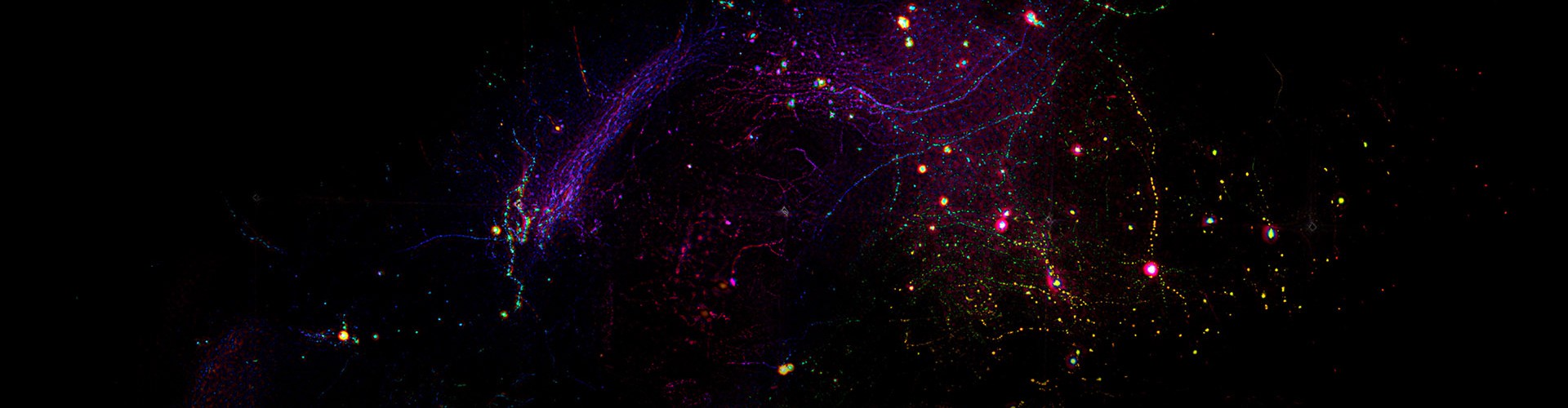
The laboratory of imaging and intelligent technology has developed a novel volumetric 3D printing technology: Digital Incoherent Synthesis of Holographic light fields (DISH). By extending computational optics to the field of 3D printing, this innovation has set a new speed record for volumetric 3D printing with an exposure time of just 0.6 seconds. When integrated with fluidic channels, it enables efficient, high-precision batch and successive 3D printing. These findings have been published in Nature, delivering an innovative solution for efficient, customizable manufacturing across fields including biomedicine and engineering.
3D printing is an indispensable tool for scientific research and industrial production, and breakthroughs in its speed and precision are critical to advancing domains such as biomedicine and micro-technology. Existing 3D printing technologies face a fundamental trade-off between speed and precision: traditional point-by-point and layer-by-layer fabrication ensures high precision but suffers from low efficiency, often taking tens of minutes or even hours to produce millimeter-scale objects, which is far too slow for practical research and industrial needs. Current volumetric printing techniques, such as Computed Axial Lithography (CAL), use one-step forming to boost speed but are limited by drawbacks like the need for container rotation and significant precision degradation in out-of-focus regions. What’s more, they require high-viscosity materials to prevent sample sinking, severely narrowing their scope of application.
The laboratory of imaging and intelligent technology has been a pioneer in computational optics research, achieving remarkable findings and applications in microscopic imaging, astronomical imaging, and optical computing. The research team discovered that computational optics is not only powerful for capturing light-field information, for tasks like imaging and 3D reconstruction, but can also be applied in reverse to construct physical objects using light fields, such as in 3D printing. Building on this insight, the team extended computational optics to additive manufacturing, designing a system based on the inverse process of imaging optical paths and realizing a technological leap from optical information acquisition to physical manufacturing. After five years of targeted research to tackle core technical challenges, the team has overcome a series of hurdles, including high-speed modulation of multi-view light fields, the design of holographic pattern optimization algorithms for extended depth of field, and high-precision optical path calibration via digital adaptive optics, ultimately developing the DISH technology.
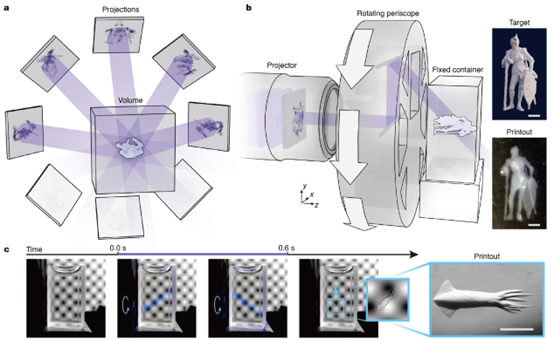
Figure 1. System design
The core innovation of DISH lies in reversing the foundational principle of computational optics: instead of recording high-dimensional imaging processes to computationally reconstruct 3D scenes, DISH modulates high-dimensional light fields to directly create 3D physical structures. By contrast, traditional 3D printing, whether using point-by-point or layer-by-layer fabrication, relies on precise mechanical movement between the printing container, materials, and probe. This approach not only limits printing efficiency but also imposes strict constraints on container design and material viscosity. Inspired by the inverse process of light-field microscopic imaging, DISH keeps the printing container and materials completely stationary throughout fabrication. It realizes 3D printing by transforming the physical formation of 3D structures into an optical challenge: the high-speed, precise modulation and projection of 3D holographic light fields.
With its innovative optical system design, DISH breaks the speed bottleneck of point-by-point and layer-by-layer scanning, capable of accurately projecting complex 3D light intensity distributions in an ultra-short time. Experimental results show the technology requires just 0.6 seconds of exposure to produce intricate millimeter-scale structures, achieving a volumetric printing rate of 333 mm^3/s, which is equivalent to generating 1.25×10^8 voxels per second. This sets a new record for volumetric 3D printing exposure time, far outperforming the 30-second benchmark of traditional volumetric printing technologies and rendering obsolete the minutes-to-hours processing times of conventional point-by-point and layer-by-layer fabrication.
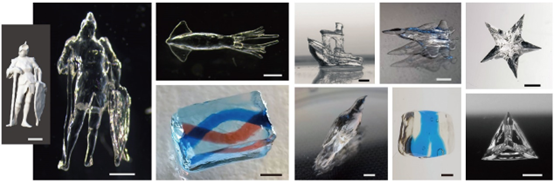
Figure 2. Complex structures produced by DISH
In traditional volumetric 3D printing, gravity-induced sample sinking causes material flow, which severely impairs print quality. As such, only high-viscosity materials can be used to mitigate this flow. Thanks to its ultra-short exposure time, DISH drastically minimizes the impact of material flow, enabling compatibility with an extensive range of materials—from dilute solutions with viscosity comparable to water to near-solid high-viscosity resins.
DISH has extremely minimal requirements for printing containers: only a single optical flat surface is needed, with no specialized container shape design required. Further, the container remains stationary during printing, eliminating the need for high-precision relative motion between the container/object stage and probe. This feature vastly expands viable printing scenarios; most notably, printing materials can be placed directly in fluidic channels to enable batch and continuous printing in a fluid environment. This ability to print directly in specialized settings like fluidic channels is a feat unattainable with traditional printing technologies, which depend on precise mechanical motion or custom-built printing vessels.
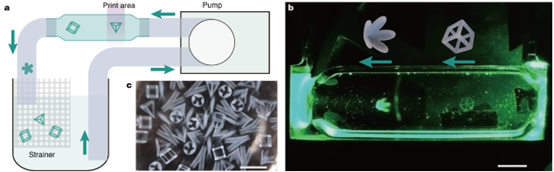
Figure 3. Ultrafast successive 3D printing in fluids
Traditional printing technologies also suffer from a common flaw: high precision near the focal plane, but with rapid precision degradation in out-of-focus areas, a problem rooted in the lack of effective methods to extend the depth of field. DISH fundamentally solves this issue through the deep integration of adaptive optical calibration, aberration correction algorithms, and holographic algorithms. A pixel-level calibration system accurately compensates for aberrations and offsets in light-field propagation, while the lab’s independently developed aberration correction and 3D holographic algorithms boost the effective depth of field from a conventional 50 micrometers to 1 centimeter under identical parameters. Experimental tests confirm the system maintains an optical resolution of 11 micrometers across the entire 1-centimeter range, and printed structures can achieve a finest resolution of 12 micrometers for independent features.
Using biocompatible materials, DISH can print spiral and bifurcated tubes that mimic natural blood vessel structures, and potentionally enable in-situ fabrication on petri dishes and biological tissues, paving new ways for advances in tissue engineering and high-throughput drug screening. In engineering, the technology is poised to be integrated into industrial pipe lines for the mass manufacturing of micro-components, such as photonic computing devices and mobile phone camera modules, as well as precision parts with sharp angles and intricate curved surfaces. Looking ahead, DISH will enable the stacking of functionally distinct materials within a single printing vessel, unlocking multi-material 3D printing capabilities and expanding applications to fields including flexible electronics, micro-robotics, and high-resolution tissue engineering models. As a transformative interdisciplinary research breakthrough, DISH combines the technical strengths of optical engineering, control theory, artificial intelligence, materials science, and other disciplines, offering a novel solution for technological advancement across related fields.
This research was published in Nature on February 11, 2026, in a paper entitled Sub-second Volumetric 3D Printing by Synthesis of Holographic Light Fields. Academician Dai Qionghai and Associate Professor Wu Jiamin of the laboratory of imaging and intelligent technology, alongside Professor Fang Lu of Tsinghua’s Department of Electronic Engineering, are the co-corresponding authors. Postdoc Wang Xukang and Ma Yuanzhu, and PhD Candidate Niu Yihan, are the co-first authors. The research was funded by the National Natural Science Foundation of China, the Ministry of Science and Technology of China, and other key national research programs.

 Mailbox:qhdai@tsinghua.edu.cn
 Address:3rd floor, Central Main Building, THU, Beijing
 Fax:+86 10 62773433